
Expertise in the Physical
Characterisation of Materials

MCA Services
Unit 1A Long Barn, North End, Meldreth, Cambridgeshire SG8 6NT UK
01763 262333
© MCA Services


Permeability and Tortuosity Measurement
Sample permeability and tortuosity testing is offered as an extension to our standard
Mercury Intrusion Porosimetry analysis and also includes the calculation of bulk density,
skeletal density and sample porosity, allowing for porosity and permeability to be measured
by a single analysis. This has proven to be particularly applicable and beneficial to a range of
materials and areas as an abundance of information is derived in a relatively short time
frame.
•
Geotechnical testing
•
Hydrology
•
Petrology
•
Catalysis
•
Paper
•
Pharmaceutical tablet forms
•
Filter media
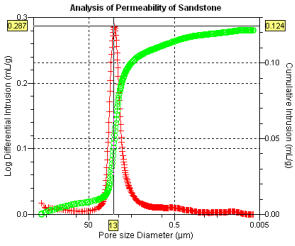
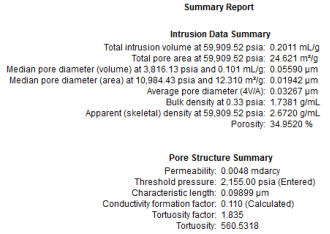
The calculation of permeability (mD) requires the threshold pressure of mercury intrusion,
the bulk sample density and the absolute sample density. The threshold pressure is assessed
from mercury intrusion data and the large number of data points generated by our in-house
protocols allows for this to be calculated with accuracy. Bulk (envelope) density is also
determined from mercury intrusion data whilst the absolute density can be entered either as
a known or assumed value for the material or measured using our helium pycnometry
option.
Sample tortuosity provides a measure of the difference between the actual path length
through sample pores and the geometrically shortest distance through the sample. The
generation of tortuosity data requires sample permeability and an estimate of the BET
Surface Area of the sample. The surface area may be provided from a known or assumed
value or can be measured using our BET Surface Area analysis options, applying either
nitrogen or krypton adsorption.
















Expertise in the Physical
Characterisation of Materials
MCA Services
Unit 1A Long Barn, North End,
Meldreth, Cambridgeshire SG8 6NT UK
01763 262333
© MCA Services
Permeability and Tortuosity Measurement
Sample permeability and tortuosity testing is offered as an
extension to our standard Mercury Intrusion Porosimetry analysis
and also includes the calculation of bulk density, skeletal density
and sample porosity, allowing for porosity and permeability to be
measured by a single analysis. This has proven to be particularly
applicable and beneficial to a range of materials and areas as an
abundance of information is derived in a relatively short time
frame.
•
Geotechnical testing
•
Hydrology
•
Petrology
•
Catalysis
•
Paper
•
Pharmaceutical tablet forms
•
Filter media
The calculation of permeability (mD) requires the threshold
pressure of mercury intrusion, the bulk sample density and the
absolute sample density. The threshold pressure is assessed from
mercury intrusion data and the large number of data points
generated by our in-house protocols allows for this to be calculated
with accuracy. Bulk (envelope) density is also determined from
mercury intrusion data whilst the absolute density can be entered
either as a known or assumed value for the material or measured
using our helium pycnometry option.
Sample tortuosity provides a measure of the difference between
the actual path length through sample pores and the geometrically
shortest distance through the sample. The generation of tortuosity
data requires sample permeability and an estimate of the BET
Surface Area of the sample. The surface area may be provided from
a known or assumed value or can be measured using our BET
Surface Area analysis options, applying either nitrogen or krypton
adsorption.


01763262333